
Laser engravers use different types of laser sources, and the wavelength of the laser plays an important role in how the machine interacts with different materials.
Among consumer and industrial laser engraving solutions, diode laser engravers and CO₂ laser engravers are two common types. The Longer Ray5 laser engraver uses a 450nm blue diode laser, while CO₂ lasers work with infrared wavelengths.
This article explains the basic differences between these two laser technologies from the perspective of wavelength, working principles, and applications.
Understanding Laser Wavelength
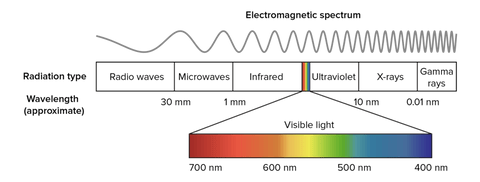
In physics, the transmission of electromagnetic energy through space is called electromagnetic radiation.
Different wavelengths create different types of electromagnetic radiation. The range between approximately 400nm and 700nm is called visible light, which can be detected by the human eye and converted into visual signals by the brain.
The light we see every day belongs to this wavelength range.
The Relationship Between Wavelength and Frequency
Wavelength and frequency are inversely related. This means:
- A shorter wavelength has a higher frequency.
- A longer wavelength has a lower frequency.
For example:
- Radio waves used for FM and TV broadcasting have wavelengths much longer than visible light.
- Microwaves operate at higher frequencies.
- Visible light reaches the terahertz (THz) frequency range.
- Some radiation generated by nuclear processes has extremely short wavelengths.
The wavelength also affects how electromagnetic radiation interacts with materials. Generally, longer wavelengths can pass through certain materials more easily than shorter wavelengths.
A simple example is that radio waves can pass through walls, while visible sunlight is blocked by many solid objects.
450nm Diode Laser Engraver
Laser beams have different colors depending on their wavelengths. A blue diode laser, such as the one used in the Longer Ray5 laser engraver, has a wavelength of 450nm. Other visible laser colors, such as red or green, have different wavelengths.
However, not all laser beams are visible to the human eye. Some lasers operate in the infrared spectrum, which cannot be seen directly but can still provide strong processing capabilities.
CO₂ Lasers
An example of an infrared laser is the CO₂ laser, which is a laser characterized by a wavelength between 940 nm and 1060 nm, which is generated within an active laser medium contained in an air- or water-cooled gas discharge tube.
The gas contained within the laser tube consists mainly of carbon dioxide (CO2) and other gases, where an initial gas is excited by electric current but is not able to release a photon because of its chemical structure and then transfers its energy to a CO2 molecule that triggers the first photon.
The operation is similar to a neon/fluorescent bulb, although in this case the photons generate a laser beam instead of optically isotropic light. Given the high power obtainable (as the ratio between input and output power is very high), CO₂ lasers are widely used for metal engraving, for cutting materials, and for industrial welding.
They are also very useful in surgery because the main constituent, water, of the cells absorbs very well the emitted infrared frequency. In addition, CO₂ lasers are also used for telemetry, as infrared can pass through the Earth's atmosphere easily, being almost completely transparent to infrared.
Conclusion
Both diode laser engravers and CO₂ laser engravers have their own advantages. The main differences come from their laser sources, wavelengths, and typical application areas.
A 450nm diode laser, such as the one used in the Longer Ray5, provides a compact and practical solution for creators who want to explore laser engraving and cutting projects. CO₂ lasers, on the other hand, are commonly used for higher-power industrial applications.
Understanding the differences between these laser technologies can help users choose the right laser engraver based on their project requirements.
Share:
3D RESIN PRINTER REVIEW | DON'T UNDERESTIMATE THE MIGHTY ORANGE 30
Convert a LONGER FDM 3D printer into a drawing machine